zichi Lorentz
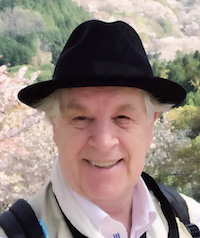
Zichi Lorentz.
Visual Artist.Commentator-Publisher.
Liverpool UK (1952-1971).
London UK (1971-1994).
Japan (1994-).
Present location:Tatsuno City. Hyogo.

SITE UPDATE Sept 2026
Introduction
some info on that

A Lifetime Art Student
I have been an art student since I was about twenty. That makes it roughly fifty years—and I still haven't graduated.
The truth is, I never consciously decided to become an artist. There was no great moment when I announced, “This is what I am going to do with my life.” One day I simply realized that I was making art every hour I was awake.
I would wake up in the morning, still in my bedclothes, look across at a painting or some other work in progress and think, I'll just do that before I get dressed.
Then I would look up again and discover that night had fallen and I was still wearing my bedclothes.
Actually, I always slept naked, so perhaps “bedclothes” is stretching the truth a little.
My living space gradually became my studio. Art took over the place—and, in many ways, it took over my life.
In the mid-1970s I held my first solo exhibition, in a gallery in Menston, West Yorkshire. All the works were silk paintings. I also took part in an exhibition at the Chenil Gallery on King's Road in London.
I was always much more interested in making the work than in selling it. The business side of being an artist never particularly interested me. Most of my paintings found homes through personal contacts rather than through any carefully planned marketing strategy.
Then, by 1979, the money was running out.
Fortunately, I discovered that I could go to college as a mature student and receive a surprisingly generous student grant—especially when compared with today's situation.
So, from 1979 to 1982, I attended what was then North East London Polytechnic, now the University of East London.
For the first two years I studied for a Diploma in Higher Education by Independent Study. This was perfect for me because it meant I could design my own programme of study.
And I did something that might seem strange for an art student: I stayed away from the Art Department.
Instead, I went to the Textile Department.
There I met a wonderful tutor, Doreen Dyall RA. Looking back, it was one of the best decisions I could have made. Doreen and I developed a very good tutor-student relationship, and the Textile Department gave me the freedom and encouragement I needed to develop my own work.
During this period I also joined the 62 Group of Textile Artists and took part in their exhibitions.
In my second year I was invited to transfer to Goldsmiths College. It was a tempting offer, but there was a catch: I would have had to start again from the first year. That would also have meant losing my grant for the final year.
More importantly, I was enjoying what I was doing. I had no desire to throw away something that was working simply because another institution had a more impressive name.
I never went to college because I was particularly interested in qualifications. I went because I wanted time, space and freedom to develop my creations.
I eventually got my diploma and enrolled for another year to work towards a BA (Hons). Halfway through, however, I lost interest in the whole college experience and dropped out.
And that was perfectly all right with me.
After all, I am a lifetime art student.
I only get to graduate at the moment of my death.
The Survival Years
From 1988 to 1994, art gradually became less and less of my life. I was doing more and more of what might simply be called survival.
Then, in 1994, everything changed.
My Japanese partner and I moved to Tokyo. We spent our first six months there before moving to the beautiful Japanese Alps, where we stayed until the end of 2002. Then we moved to Kobe City.
Since arriving in Japan, I have once again been a full-time art student—and a full-time artist.
There was one important difference this time.
I had to learn the business side.
In Japan there was no alternative way for me to survive. I couldn't simply ignore the commercial side of being an artist. It was rather brutally simple:
**It was live or die.**
So I learned.
Every day I create. I have created art, exhibited art and sold art. To date, I have sold more than 300 works.
Shortly after arriving in Kobe, I held an important exhibition.
Materials, Speed and Survival
These days I concentrate mainly on acrylic painting, and watercolours.
I work on wood, canvas, silk and paper—particularly Japanese silk paper.
There is an important detail about the silk I use. I use spun silk, which means the silk moth is not killed. The silk and silk paper I use are made from what would otherwise be discarded material.
So there is a recycling element to it as well.
I particularly like acrylics for practical health reasons, but there is another reason that matters much more to me:
**I like to work fast.**
I don't want too much time to think.
With oils, there is a lot of thinking time. Acrylics allow me to work quickly, react to what is happening on the surface and keep moving before my brain has too much opportunity to interfere.
For me, that is important.
Sometimes thinking improves a painting.
Sometimes thinking destroys it.
Painting the Mountains
During the years I lived in the Japanese Alps, I concentrated on landscape painting.
My house was also my studio, about 1,000 feet above sea level, with a wonderful view towards snow-capped mountains. I worked outside whenever I could.
But painting those landscapes wasn't always an easy or comfortable activity.
I would climb mountains carrying my painting equipment, often travelling to places that could only be reached on foot. It was physically demanding, sometimes exhausting—and occasionally dangerous.
There were wild bears.
There were snakes.
And there was the simple reality of standing in remote mountains with all your art equipment on your back, trying to paint.
But that was precisely what interested me.
I wanted to be there.
I wanted to experience the landscape rather than simply look at it from a comfortable distance.
During this period I studied the work of the great Japanese painter Higashiyama Kaii. I was fortunate that his museum was located near my studio in Nagano City, giving me the opportunity to study his actual paintings rather than merely reproductions.
Kaii continued painting until he was 99.
I was even fortunate enough to receive a letter of encouragement from him.
That meant a great deal to me.
Still Learning
Since moving to Kobe, my work has changed again.
I have returned to seascapes, along with more abstract work.
The mountains gave me one kind of experience. The sea gives me another. And abstraction gives me yet another place to explore.
Perhaps that is why I have never really thought of myself as someone who has become an artist.
I am still becoming one.
I am still learning.
I am still experimenting.
I am still making mistakes.
I am still discovering what happens when I put one mark next to another.
After forty years, I have learned that being an artist isn't necessarily about arriving somewhere.
It is about continuing to look, continuing to experiment and continuing to make.
So I remain what I have always been:
a lifetime art student.
And, if all goes according to plan, I won't be graduating anytime soon.
I kept your humor and slightly rebellious personality, but gave the story more **rhythm, narrative momentum, and memorable lines**. I also made the “lifetime art student” idea into the thread that holds the whole biography together.